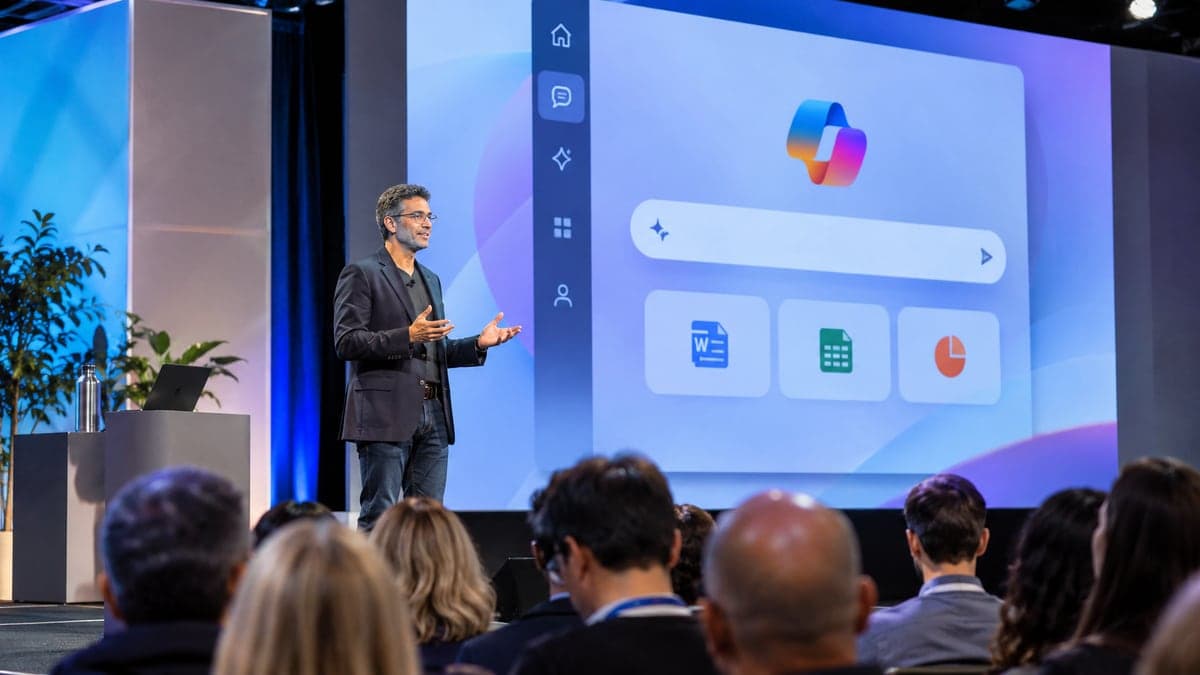
Microsoft used its Ignite keynote in San Francisco on Tuesday 17 November to announce Word, Excel and PowerPoint inside Copilot, presenting its microsoft copilot work os vision around agents, organisational data and administrative controls.
The changes matter to employees whose documents and communications could become inputs to agents, and to IT teams responsible for access, spending and oversight. They also move Copilot from an assistant within individual applications towards an interface through which Microsoft wants work to be initiated and supervised.
Office moves inside Copilot
Microsoft Chairman and CEO Satya Nadella said Copilot brings together chat, coworking, coding and Autopilot, with Office built into that experience. Users will be able to create documents, spreadsheets and presentations directly in Copilot, according to Ars Technica. The resulting files will remain editable in their respective Office applications.
The announcement forms part of a redesign first announced in September. Microsoft describes the wider arrangement as a "frontier ecosystem", built around human ambition, organisational control of intelligence and trust. Its model system is intended to match intelligence, context and interface to a task.
Copilot Home provides a starting point for answers or multi-step assignments, while Code is intended for building custom software-as-a-service applications and dashboards. Microsoft also announced role-specific extensions for sales, legal, finance and service, plus business-application plugins beginning with Dynamics 365 and a Salesforce partnership.
The practical effect is that Office files can be produced without starting in Word, Excel or PowerPoint. That does not remove those applications, but it changes where users begin and where agents obtain instructions and context.
Autopilot delegates continuing work
Copilot Autopilot is the clearest expression of that shift. Microsoft calls it a persistent, proactive personal-productivity agent that can keep work moving around the clock. Ars Technica reported that it is cloud-based and designed to accept delegated responsibilities rather than only individual tasks.
Users can authorise Autopilot to work across services including email and calendars. It will use usage-based billing through Copilot Credits, but Microsoft had not announced final pricing ahead of general availability. That leaves a significant budget question unresolved for organisations considering broad deployment.
Copilot Workspaces, available through Microsoft's Frontier early-access programme, is designed for people and agents to work towards a common goal with shared context. The ability to bring personal Autopilot agents into Workspaces is coming later, according to Ars Technica.
For workers, the division between assigning a task and supervising an ongoing role therefore becomes important. For administrators, the question is which mailboxes, calendars, documents and collaborative spaces an agent may reach, and who can revoke that authority.
Work IQ supplies organisational context
Microsoft IQ is the platform beneath these plans, and Work IQ is its context layer for organisational work. Nadella described it as a database with understanding of people, relationships, documents, emails, meetings, chats and projects. Microsoft IQ combines data across Fabric, Foundry and Microsoft 365 with third-party context through hundreds of new connectors.
That context could help an agent distinguish between projects and produce material using relevant internal information. It also concentrates governance questions around data that previously sat across separate communications and productivity systems. Ars Technica noted that organisations will need their own IT reviews to determine whether autonomous agents should access internal documents and messaging data.
Microsoft said more than 4,000 customers have used its generally available Microsoft-Decision-1.1 model, which adds multimodal support and is intended to improve decision accuracy and response speed. It also announced GPT 6.2 and Meta's latest models for Foundry, its Code 2 coding models and the generally available Cyber 2 Flash security model. These announcements widen the model choices behind enterprise deployments, but do not remove the need to assess permissions and outputs.
Agent controls and spending analytics
Agent 365 is Microsoft's control plane for extending governance, identity, security and management systems to enterprise agents. Nadella said it already contains more than 50 million agents. Microsoft says each Autopilot agent will have a unique ID, administrators can restrict permissions or block it, activities are logged for human review, and approval can be required before specified actions.
Nadella also said Microsoft can see almost everything models touch but not what happens inside a model, and that a model's account of itself is not independent evidence. His proposed approach is to verify actions independently and control what AI is allowed to do. The effectiveness of those safeguards against mistakes, unauthorised actions or data exposure remains to be demonstrated in customer environments.
Agent 365 Business Analytics adds a financial layer. Microsoft compares it to an enterprise resource planning system for AI usage, showing what drives spending and connecting spending to outcomes. Customers will be able to examine token costs alongside the value of work performed.
However, Microsoft acknowledged that estimates of assisted work hours are determined by a model, not direct measurement of time saved. Finance and IT leaders should therefore treat those figures as estimates when assessing return on investment, rather than as observed productivity gains. Judson Althoff, CEO of Microsoft Commercial Business, said: "anything you can do with Claude or ChatGPT, you can do better with Copilot, for less." That is a vendor comparison, not an independently established result.
Trust extends beyond product controls
Microsoft announced its AI Transparency Initiative to develop open, industry-wide standards for governance, transparency and security. Ars Technica reported participation by more than 40 companies, including Adobe and Mastercard. Microsoft said it would expand collaboration in the National Institute of Standards and Technology's Agent Standards Initiative.
The company also made Perception generally available. It describes this as an agentic security system in which red agents simulate attacks, blue agents detect them and green agents fix and remediate, with playbooks composing teams for complex jobs.
Nadella briefly addressed the previous week's disruption to services including Exchange Online and Teams. "We know the trust you place in our services and take that responsibility extremely seriously, and in that context I know we have work to do," he said. DailyTech.press has separately covered Microsoft's account of its 365 outage.
The Ignite announcements give buyers specific items to test: agent identities, permission boundaries, approval workflows, logs, connector access and the assumptions behind analytics. They also leave final Autopilot pricing and evidence of real-world savings unresolved. Organisations deploying assistants can compare those controls with guidance on using AI assistants safely at work and the distinction between conversation and action in an explanation of AI agents.
For Microsoft, the microsoft copilot work os pitch now depends less on whether Copilot can draft a document than on whether customers accept it as a supervised layer across work. Adoption will turn on administrative control, measurable value and confidence in the infrastructure beneath it.