Microsoft expanded its microsoft enterprise ai portfolio on Tuesday 17 November at Ignite 2026, introducing three in-house models, collaborative agents and tools for tracking corporate AI spending.
The announcements matter to businesses deciding whether to buy models, productivity software and agent controls from separate suppliers or a single platform. They also give Microsoft more scope to reduce its reliance on OpenAI and Anthropic, companies whose technology it sells and in which it invests.
Microsoft enterprise AI models target routine work
Microsoft introduced MAI Code 2 and Code 2 Flash for what it described as everyday coding tasks, according to ZDNET. It also announced MAI Work Flash, derived from Code 2 Flash, for activities including generating Excel formulas, working with Word documents and extracting information from Teams.
The company said MAI Code 2 achieved 96% of Claude Opus 5.5 performance at 5% of that model's price. Microsoft also said Code 2 offered comparable performance to GPT-6.1 Sol or Opus 5.5, while Code 2 Flash was comparable to GPT-6 Luna and Claude Haiku 5.5 at considerably lower cost.
Those figures concern usage-based application programming interface pricing, not consumer subscriptions. ZDNET reported that the benchmarks were supplied by Microsoft and that independent tests could produce different results. Microsoft also said its reported numbers used a 50% introductory discount.
The models are optional choices for GitHub Copilot, Microsoft 365 and Fabric. Microsoft said they were not designed for the most challenging agentic and research workloads, positioning them instead for high-volume, comparatively routine requests.
Cost claims need independent scrutiny
The pricing comparison is central to Microsoft's pitch, but it does not establish that every customer will reduce spending by the same proportion. Model choice, task mix, usage patterns and the introductory discount could all affect actual bills.
ZDNET illustrated the possible economics with a hypothetical example rather than a Microsoft forecast. It calculated that reducing a request's cost from $0.01 to $0.001 would cut a hypothetical $1 million daily inference bill to about $100,000, producing annual savings of $325 million.
That example shows why Microsoft could be a significant beneficiary of its own models. Lower internal inference costs could matter across a large product range, while greater vertical integration would give the company more control over which systems handle routine requests.
GeekWire reported that Microsoft also presented a chart comparing monthly business costs per user: $30 for Copilot, $81 for ChatGPT and $205 for Claude. The comparison came from Microsoft, which invests in OpenAI and Anthropic and sells their models, making the basis of such comparisons particularly important for buyers to examine.
Workspaces and Autopilot extend agent controls
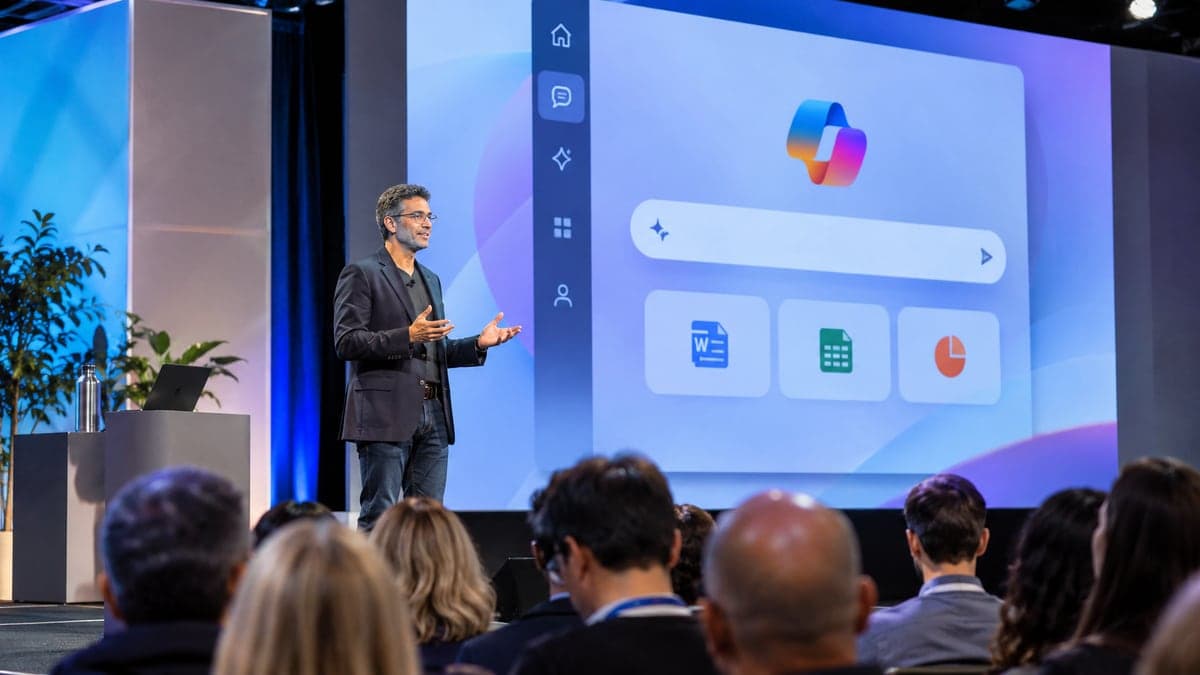
Chief executive Satya Nadella announced Copilot Workspaces during the keynote. Microsoft described it as a collaborative, multiplayer surface for Copilot's agentic capabilities and an evolution of Copilot Notebooks.
The product is available through Frontier for now. Microsoft said people and agents can build on each other's work, with an agent drafting part of a document and responding to comments left by a user. ZDNET compared the approach with OpenAI's ChatGPT Space and Anthropic features including Whiteboard and Sheets.
Microsoft also announced Autopilot, an agent designed to watch Teams channels, follow up on emails, run recurring work and manage projects without waiting for a prompt. Employees can tag it like a colleague and assign tasks, according to the company.
Autopilot is also available in Frontier. Microsoft said each instance has its own Microsoft Entra Agent ID and a named manager, allowing IT teams to block it where necessary. Sign-ins and actions are logged under its own name, while Work IQ operates within existing permissions, the company said.
Those controls address a practical concern as organisations give software more autonomy. Businesses need to establish which identity an agent uses, what it can access and who is responsible for its activity; DailyTech.press has separately examined what makes an AI agent different from a chatbot.
Microsoft adds AI spending and measurement tools
Microsoft announced Agent 365 Business Analytics and Agent 365 Cost Management for organisations monitoring agent activity and expenditure. Agent 365 is the company's observability platform, first announced in 2025.
Business Analytics entered Frontier Public on 17 November. Microsoft said it shows what a company is spending on AI, why costs arise and where the investment is paying off, alongside forecasts of future costs. A keynote demonstration showed administrators identifying recent spikes in individual agents' costs and the employee to notify.
Microsoft said its measurement approach focuses on work completed rather than simply tokens. It analyses tasks, the time the work typically takes a person and the share performed by Cowork to estimate the hours supported and the work's value.
Cost Management lets IT teams examine AI use down to the model. Microsoft said leaders can set spending policies, limits and proactive alerts, and control which models are available.
The tools could help organisations impose budgets and audit activity, but their valuations still depend on Microsoft's methodology. Customers will need to compare those estimates with their own productivity and financial records before treating them as realised returns.
What businesses should watch next
The immediate test is availability and independent evaluation. Workspaces and Autopilot remain in Frontier, Business Analytics is in Frontier Public, and the model performance figures have not yet been validated by the independent testing ZDNET said could change the picture.
Buyers should examine workload coverage, pricing after the introductory discount and the assumptions behind any savings calculation. They should also assess whether agent identities, logs and spending limits fit existing governance arrangements, particularly as workplace AI becomes more autonomous; separate guidance covers using AI assistants safely at work.
The broader microsoft enterprise ai strategy now spans models, applications, agents, identity and financial controls. Microsoft's announcements strengthen that integrated offer, while leaving customers to verify whether its cost and performance comparisons apply to their own workloads.