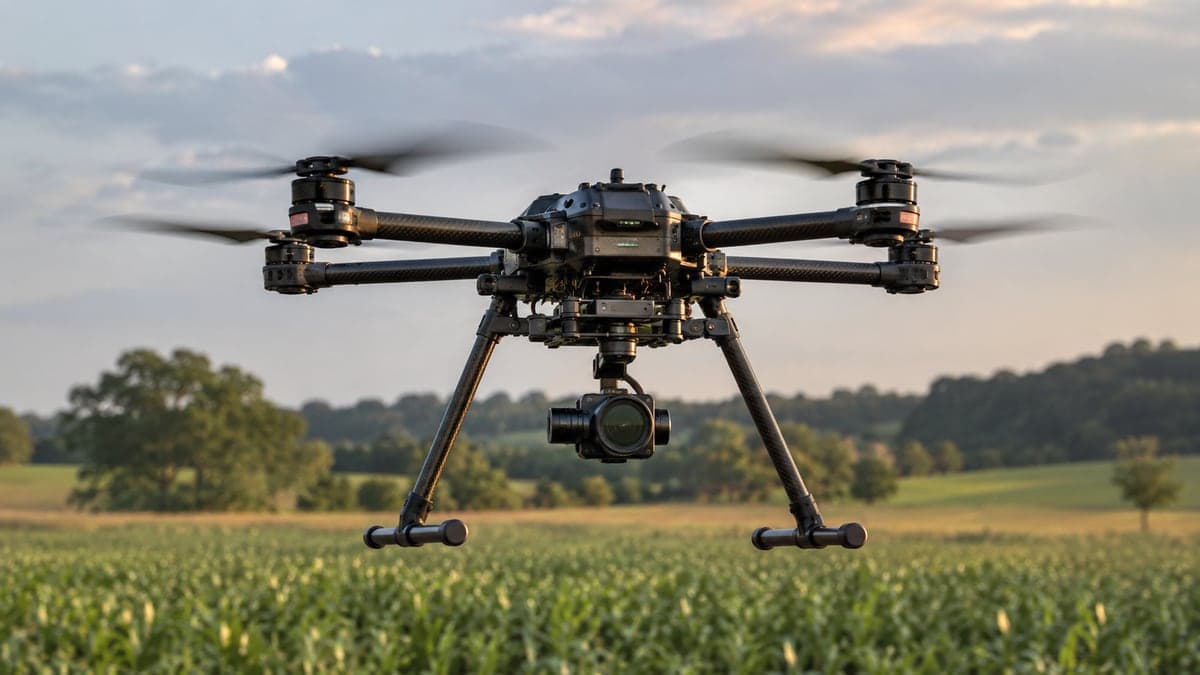
For a decade, consumer drones were essentially flying cameras on a joystick. The pilot did the thinking; the aircraft held its position and tried not to crash. With AI drones, that division of labour is breaking down. Small, efficient processors and mature computer vision now let drones understand their surroundings well enough to fly themselves: following a subject through a forest, inspecting a wind turbine blade by blade, or mapping a field without a human touching the sticks.
That is a genuine engineering achievement. It is also a turning point that regulators, militaries and the public are still catching up with.
What autonomy actually adds
The word "AI drone" covers a wide spectrum. At the modest end, it means obstacle avoidance and automated return-to-home. Further along, it means visual navigation that works without satellite positioning, object recognition that can pick out a person, vehicle or crack in concrete, and mission planning that adapts in flight. Much of this runs on the aircraft itself, part of the same shift as on-device AI in phones and PCs.
The practical gains are easiest to see in civil and industrial work:
- Infrastructure inspection. Bridges, power lines, rail track, pipelines and turbines can be surveyed more often and more safely, with software flagging anomalies for human engineers.
- Agriculture. Crop monitoring and targeted spraying reduce waste and let farmers act on problems field by field.
- Emergency services. Search and rescue teams use thermal imaging and automated search patterns to cover ground quickly.
- Logistics. Medical deliveries to remote or congested areas have been trialled in several countries, with mixed but promising results.
In each case, autonomy changes the economics. When a drone no longer needs a skilled pilot watching every second, one operator can supervise several aircraft, and routine missions become cheap enough to run routinely.
Autonomy changes the economics before it changes the technology. When flying stops needing a pilot, it stops being special.
The battlefield lesson
No honest discussion of drones in 2026 can ignore war. The conflict in Ukraine has demonstrated, in public and at scale, how inexpensive drones can reshape military tactics. Small first-person-view drones, many built from commercial components, have become a defining weapon, and both sides have invested heavily in electronic warfare to jam them.
That jamming is one of the main drivers of autonomy. If the radio link to a pilot can be severed, a drone that can complete the final stage of its flight using on-board vision becomes far more effective. The techniques involved are not exotic; they draw on the same computer vision research that powers consumer follow-me modes and industrial inspection.
This is the dual-use problem in its sharpest form. The same algorithms that help a rescue drone find a missing walker can help a weapon find a target. It is why debates at the United Nations about lethal autonomous weapons systems, and about meaningful human control over the use of force, have taken on new urgency, even as agreement on binding rules remains elusive.
Risks closer to home
For most Europeans, the more immediate risks are civil. Drones near airports have caused serious disruption before; the shutdown of Gatwick in December 2018 after reported sightings remains the textbook example of how a small aircraft can paralyse critical infrastructure. Drones have been used to smuggle contraband into prisons and to conduct surveillance of sensitive sites.
Privacy is the slower-burning concern. An autonomous drone with a high-resolution camera and on-board recognition is a powerful surveillance tool, whether operated by a business, a public authority or a nosy neighbour. Data protection law, including the GDPR, applies to drone footage of identifiable people, but enforcement is difficult when the operator may be invisible and the flight lasts minutes.
The same algorithm that finds a missing walker can find a target. Policy has to start from that fact, not avoid it.
How the rules for AI drones are evolving
Europe has a reasonably coherent starting point. EU rules applied by EASA since 2021 sort drone operations into "open", "specific" and "certified" categories according to risk, with requirements for registration, pilot competence and, for higher-risk flights, formal risk assessment. The UK runs a broadly similar risk-based system through the Civil Aviation Authority. Remote identification, which lets authorities identify drones in flight, is becoming standard.
What these frameworks were not designed for is a world where large numbers of drones fly beyond the operator's line of sight with significant autonomy. That requires:
- Reliable traffic management for low-altitude airspace, often called U-space in the EU.
- Clear certification standards for autonomous decision-making software, alongside broader AI rules such as the EU AI Act.
- Lawful, proportionate counter-drone powers for police and infrastructure operators.
- Privacy safeguards that work in practice, not just on paper.
Innovation and risk, both at once
The honest answer to the question in the headline is that AI drones are both an innovation and a new risk, and the two cannot be separated. The industrial benefits are too large to forgo, and the technology is too widely available to contain. The task for policymakers and companies is to make sure the civil ecosystem grows with safety, accountability and privacy built in, while the harder questions about autonomous weapons are confronted rather than deferred.
The sky is getting busier and smarter. Whether it also gets safer depends on decisions being made now.