Eight years after launch, the joint European-Japanese BepiColombo mission has begun bepicolombo mercury orbit operations. The European Space Agency announced the arrival on 21 November, saying a module manufactured in Europe had entered orbit and started a months-long manoeuvring sequence.
The arrival gives planetary researchers a second orbital mission at the Solar System’s innermost planet. NASA’s MESSENGER was the first, operating in orbit during 2011–2015. BepiColombo will use two probes at different altitudes, allowing scientists to examine Mercury’s surface and its surroundings from complementary vantage points.
What BepiColombo can study at Mercury
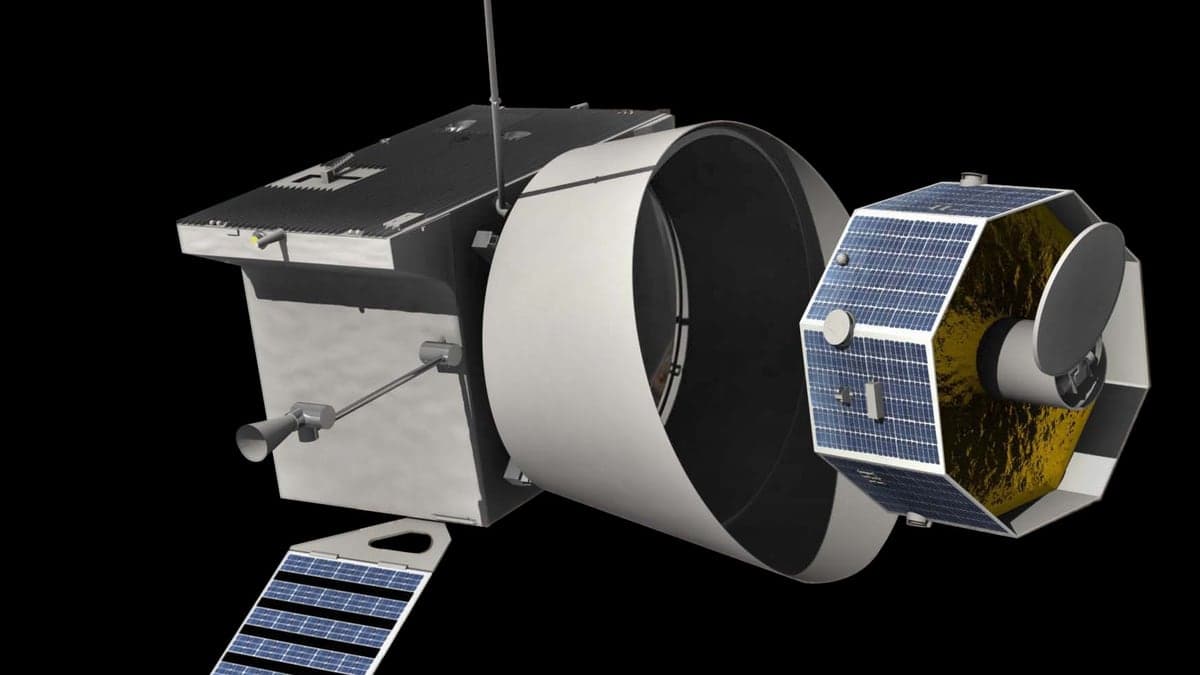
For the present, the pair will stay joined together, according to Nature. Their separation is planned once the mission reaches the orbit designated for Japan’s MIO probe on 9 December.
JAXA, Japan’s space agency, built MIO. Its elliptical paths will take it from 500 km above Mercury out to 11,000 km. Along that route, MIO will gather measurements of Mercury’s magnetic field and investigate the solar wind’s interaction with it.
The European probe is the Mercury Planetary Orbiter, or MPO. After separation, it will gradually descend until March 2027. Its final orbit will range between 400–1,500 km, according to the mission details reported by Nature.
Continuous observations of the surface are planned once MPO reaches that lower path. The division of labour is central to the mission: MIO will concentrate on the magnetic environment and solar-wind interaction, while MPO will observe the surface from a much lower altitude.
The bepicolombo mercury orbit phase therefore does not begin with a single spacecraft circling the planet. It starts with a sequence of manoeuvres that will place two scientific platforms on separate paths, each suited to a different set of measurements.
An X-ray camera tested before arrival
Among MPO’s instruments is an X-ray camera called MIXS. The device is intended for the mission’s scientific work at Mercury.
The spacecraft was able to test some onboard instruments during its journey. For one test, mission scientists aimed MIXS towards the Crab Nebula. Nature describes this object as debris from a stellar explosion observed from Earth in 1054.
According to Emma Bunce, no earlier interplanetary mission has carried an X-ray imaging device like MIXS. She is a University of Leicester plasma physicist in the UK and a leading scientist on the mission.
That observation provided an in-flight test before the probes begin their separate work. It also demonstrates that the journey was used for instrument checks rather than only for navigation and propulsion.
Why reaching Mercury required a difficult route
BepiColombo launched in October 2018. Its eight-year passage reflects the difficulty of travelling to a planet close to the Sun, rather than a shortage of distance to cover.
Bunce called journeys towards the Sun’s neighbourhood a “prolonged affair”. She said: “Energetically, it takes more energy to go to Mercury than to go to the outer Solar System.”
The spacecraft needed a gradual approach towards the Sun while keeping its speed under control. Otherwise, it risked moving too quickly and passing beyond Mercury. That constraint explains why arrival involved a long sequence rather than a direct dash towards the planet.
The orbital insertion announced by the European Space Agency is consequently one stage in a longer process. The module still has months of manoeuvres ahead, and the European orbiter will not reach its operating orbit until March 2027.
What happens next for the two probes
The immediate milestone is the planned separation around MIO’s prescribed orbit on 9 December. The Japanese probe will then begin its elliptical path, with altitudes ranging from 500 km up to 11,000 km.
MPO’s descent will continue after that separation. Its target is the 400–1,500 km orbit scheduled for March 2027, where continuous surface studies can begin.
The timetable means the mission’s scientific work will develop in stages. MIO’s magnetic-field and solar-wind measurements belong to one orbital regime, while MPO’s surface observations belong to another. Neither probe duplicates the other’s planned path.
For readers following other spaceflight developments, a related DailyTech.press report covers Amazon Leo satellites and a Vulcan launch finding. Separate reporting on a Voyager 1 milestone is not part of this mission’s account; the BepiColombo details here come from Nature’s report.
The next confirmed dates in that account are 9 December for MIO’s prescribed orbit and March 2027 for MPO’s arrival at its lower operating orbit.