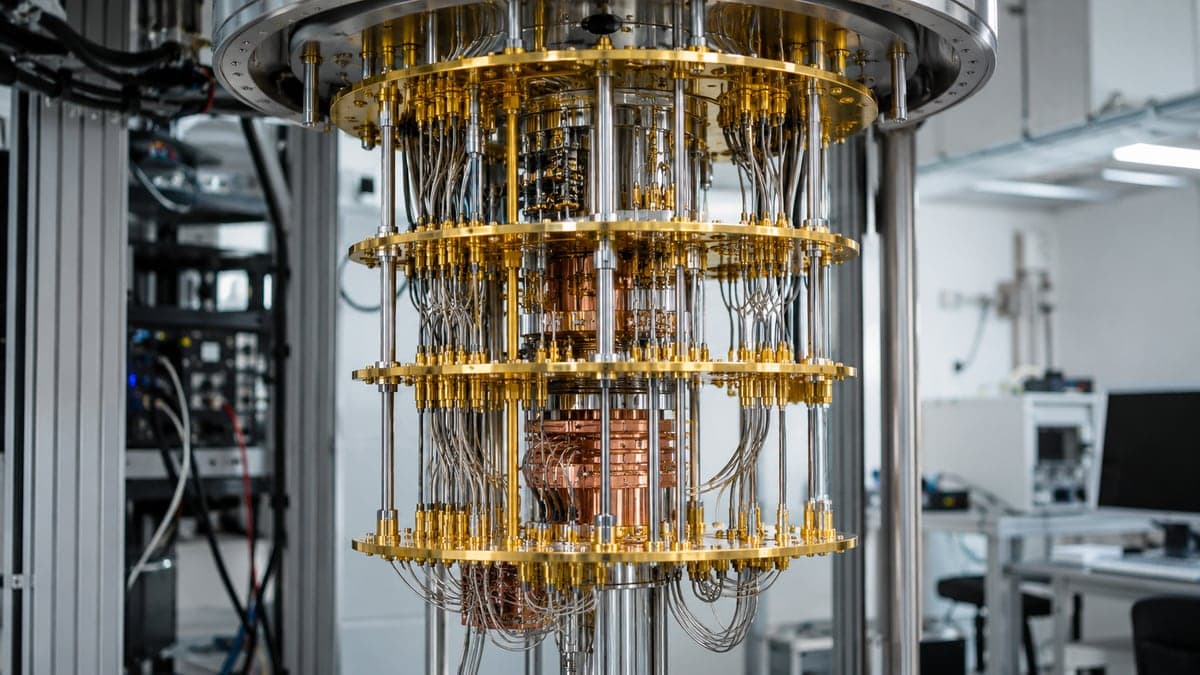
The IBM Quantum System Two in Chicago is now running, and unusually for a quantum computer, passers-by can see it. IBM, the University of Chicago and the State of Illinois unveiled the machine at a ribbon-cutting at UChicago's Hyde Park Labs on 6 November 2026, according to IBM's own account. It is IBM's first quantum computer in Illinois, and it sits at street level behind large windows on 53rd Street.
The installation is about more than one machine. It is the physical anchor of a state strategy to make Chicago a hub for quantum software, algorithms and industrial applications, and a test of whether regional clusters can turn quantum hardware into useful results.
What IBM Quantum System Two in Chicago actually is
Quantum System Two is IBM's modular platform for housing its superconducting quantum processors, with the cryogenic and control hardware needed to run them. The Chicago system uses the IBM Quantum Nighthawk r2 processor, which IBM describes as part of its most advanced line of chips. IBM chief executive Arvind Krishna called it the company's first quantum computer for the Illinois park, according to The Quantum Insider's report on the launch.
The Hyde Park site is temporary. The machine's long-term home is the Illinois Quantum and Microelectronics Park (IQMP), a 128-acre campus under construction on the former U.S. Steel South Works site on Chicago's Southeast Side. The state has committed $500 million to the park, which is led by chief executive Harley T. Johnson, a University of Illinois professor. Johnson described the installation as probably "the most publicly visible quantum computer in the world."
Putting a quantum computer behind a shop-front window is a statement: the hardware is no longer the whole story, the ecosystem around it is.
Why the National Quantum Algorithm Center matters
The system anchors the National Quantum Algorithm Center (NQAC), which Illinois Governor JB Pritzker established in 2024 with IBM as a leading member. The bet is that the bottleneck in quantum computing is shifting from building qubits to finding problems where they actually beat classical computers.
The first NQAC "Grand Challenge" projects, announced in April 2026, are aimed squarely at that question:
- Drug discovery: Deloitte and AbbVie, working with IBM and Northwestern University, on molecular simulation.
- Power grids: EPRI and the University of Illinois Urbana-Champaign on grid optimisation, a growing concern as AI data centres strain electricity supply.
- Physics: Fermilab on high-energy physics problems.
- Other sectors: advanced manufacturing, finance and logistics.
The research case so far
IBM points to several recent results from its Illinois partners. A UChicago and IBM team reported a quantum advantage demonstration on a structured task in 2026, completing the calculation in about 15 minutes with a built-in way to verify the answer. Verification matters because many past advantage claims were hard to check or were later matched by improved classical methods.
In chemistry, a UChicago group led by Joanna Wang combined a classical method with IBM's sample-based quantum diagonalization to model a 26-electron, 24-orbital fragment of an iron porphyrin, a system too large for practical exact classical calculation. The work was published in PNAS and the tool is being released as open-source software. Separately, the University of Illinois and its National Center for Supercomputing Applications have linked their DeltaAI supercomputer to an IBM quantum system, with a first demonstration due at the SC26 supercomputing conference this month.
That hybrid model, with quantum processors working as accelerators alongside classical supercomputers, is where most near-term value is expected.
What to watch, and what it means for security
The honest caveat is that a ribbon-cutting is not a breakthrough. Independent confirmation that the Chicago system delivers useful advantage on real research problems will take time, and today's machines remain small and noisy compared with what large-scale, error-corrected quantum computing would require.
The things worth tracking over the next year:
- Peer-reviewed results from the NQAC Grand Challenges, not just press releases.
- Verified advantage on problems that industry partners care about.
- The move to IQMP and whether the park attracts more hardware makers and startups.
- Jobs and skills: IBM's FutureNow Chicago centre, announced earlier in 2026 with City Colleges of Chicago, is expected to bring 750 jobs across AI, cybersecurity, data science and quantum.
For businesses, the more immediate quantum issue is defensive. Cryptographically relevant quantum computers are not here yet, but data stolen today could be decrypted later, which is why the migration to post-quantum cryptography should already be on security roadmaps. Countries are also treating compute as strategic infrastructure, a theme we explored in our piece on the sovereign cloud. Chicago's quantum park is the same instinct applied to the next generation of computing.