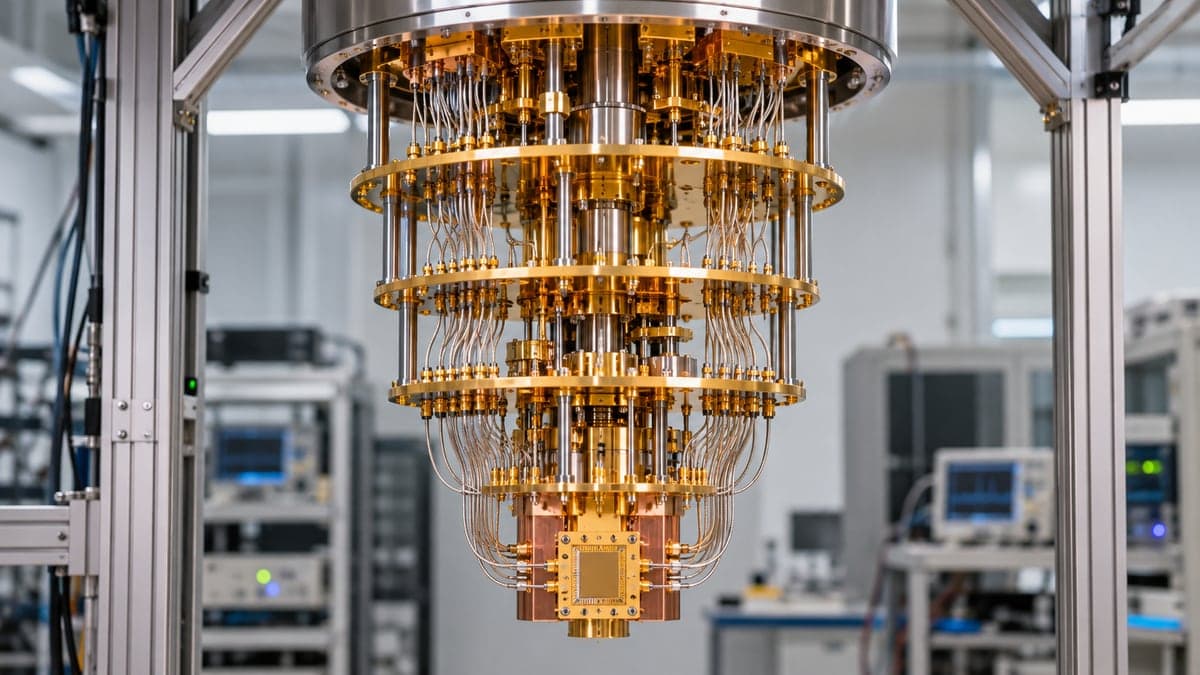
Nobody can say with confidence when a quantum computer capable of breaking today's encryption will exist. Estimates range from the next decade to considerably later, and some sceptics doubt the engineering will ever scale. Yet governments, banks and technology companies are already rebuilding the cryptographic foundations of the internet around post-quantum cryptography. The reason is simple arithmetic about time.
What quantum computers threaten
Most secure communication on the internet relies on public-key cryptography, chiefly RSA and elliptic-curve schemes. These are used to agree encryption keys, to sign software updates and to prove that a website is who it claims to be. Increasingly, they also underpin the passkeys replacing passwords. Their security rests on mathematical problems, such as factoring large numbers, that are impractical for classical computers to solve at the relevant sizes.
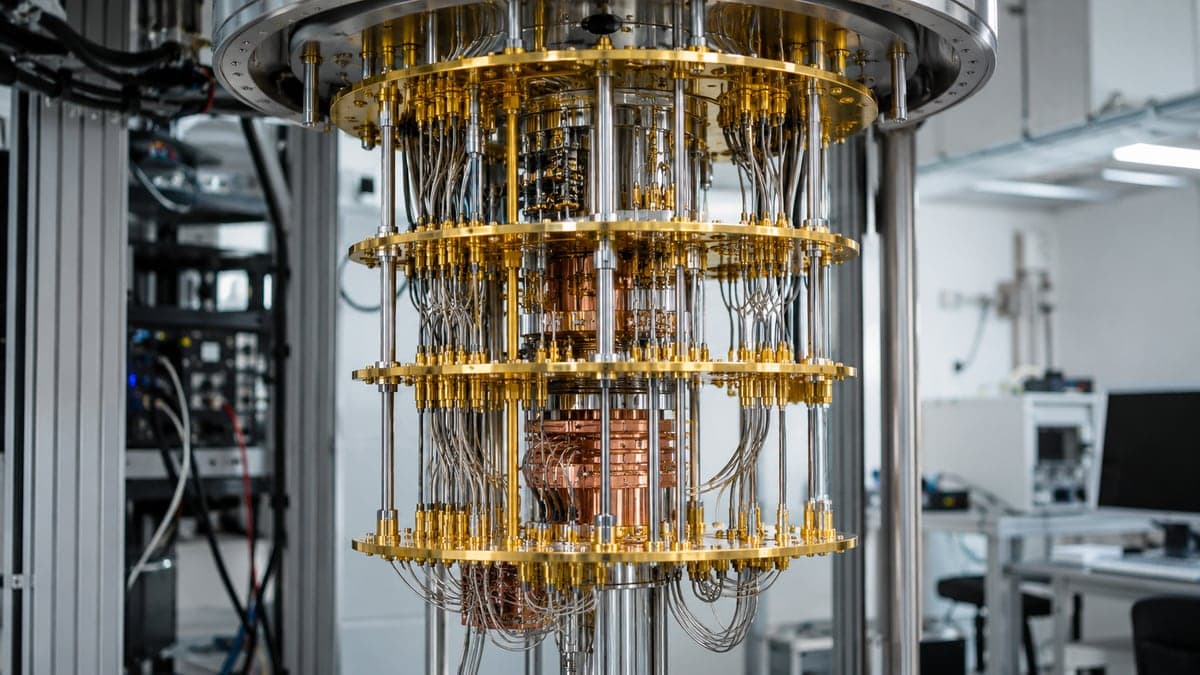
In 1994, the mathematician Peter Shor showed that a sufficiently large, error-corrected quantum computer could solve these problems efficiently. That machine does not yet exist. Today's quantum processors are impressive scientific instruments, but they remain far too small and too error-prone to threaten real-world keys. The gap between where the hardware is and where it would need to be is large, though progress in error correction has been steady.
Symmetric encryption, such as AES, is in a much better position. Quantum algorithms offer a smaller speed-up against it, and using longer keys is generally considered a sufficient response.
Harvest now, decrypt later
If the machine is years away, why act now? Because encrypted data can be recorded today and stored until it can be broken. This strategy, known as harvest now, decrypt later, means that anything with a long confidentiality lifetime is already exposed if it travels over a network protected only by classical public-key cryptography.
The deadline is not the day a quantum computer arrives. It is that day minus the number of years your secrets need to stay secret.
Think of medical records, state secrets, intellectual property, long-term financial data or personal information that will still matter in fifteen years. For these, the risk window is open now. Add the reality that large migrations take many years, and the timetable becomes uncomfortable quickly.
The new post-quantum cryptography standards
The good news is that the replacements exist. After a public competition launched in 2016, the US National Institute of Standards and Technology published its first three post-quantum cryptography standards in August 2024:
- FIPS 203 (ML-KEM), derived from CRYSTALS-Kyber, for establishing shared keys.
- FIPS 204 (ML-DSA), derived from CRYSTALS-Dilithium, for digital signatures.
- FIPS 205 (SLH-DSA), derived from SPHINCS+, a hash-based signature scheme offering a conservative alternative.
ML-KEM and ML-DSA are built on lattice problems, a family of mathematical puzzles believed to resist both classical and quantum attack. NIST has continued work on further algorithms to provide diversity in case weaknesses emerge in any single approach.
Adoption has already begun in the places that move fastest. Major web browsers and content delivery networks have rolled out hybrid key exchange that combines a classical algorithm with ML-KEM, so a connection stays secure as long as either one holds. Messaging apps including Signal and Apple's iMessage have introduced post-quantum protections for message encryption.
National agencies have also begun publishing migration roadmaps. In the UK, the National Cyber Security Centre has set out indicative milestones that aim for migration of the most important systems in the early 2030s and completion by around 2035, and US guidance points in a similar direction. Organisations should check the latest guidance from their own national authorities, as these timelines are being refined.
Why migration is hard
Swapping algorithms sounds simple. In practice it is one of the most sprawling infrastructure projects an organisation can undertake. Cryptography is embedded everywhere: in TLS libraries, VPNs, hardware security modules, smart cards, firmware, payment terminals, industrial controllers, certificates and countless pieces of custom code. Much of it is undocumented.
Post-quantum algorithms also have different characteristics. Keys and signatures are generally larger, which can affect performance and break systems with tight size limits, from embedded devices to network protocols.
The hardest part of post-quantum migration is not the mathematics. It is finding every place your organisation quietly depends on the old mathematics.
A practical starting plan
Organisations do not need to replace everything at once, but they do need to begin:
- Build a cryptographic inventory. Identify where and how public-key cryptography is used across systems, applications and suppliers.
- Prioritise by data lifetime. Start with systems that protect information which must remain confidential for many years.
- Engage suppliers. Ask vendors, including the cloud providers your infrastructure depends on, for their post-quantum roadmaps and make support a procurement requirement.
- Adopt hybrid approaches where available, combining classical and post-quantum algorithms during the transition.
- Design for crypto-agility. Build systems so that algorithms can be swapped through configuration rather than rewrites.
Crypto-agility is perhaps the most valuable long-term lesson. The industry has migrated cryptography before, from DES to AES and from SHA-1 to SHA-2, and each transition was slower and more painful than expected. Building systems that can change algorithms cleanly will pay off not only for quantum, but for whatever comes next.
The quantum clock is ticking quietly. Organisations that start now will finish on their own schedule. Those that wait may find the schedule has been set for them.