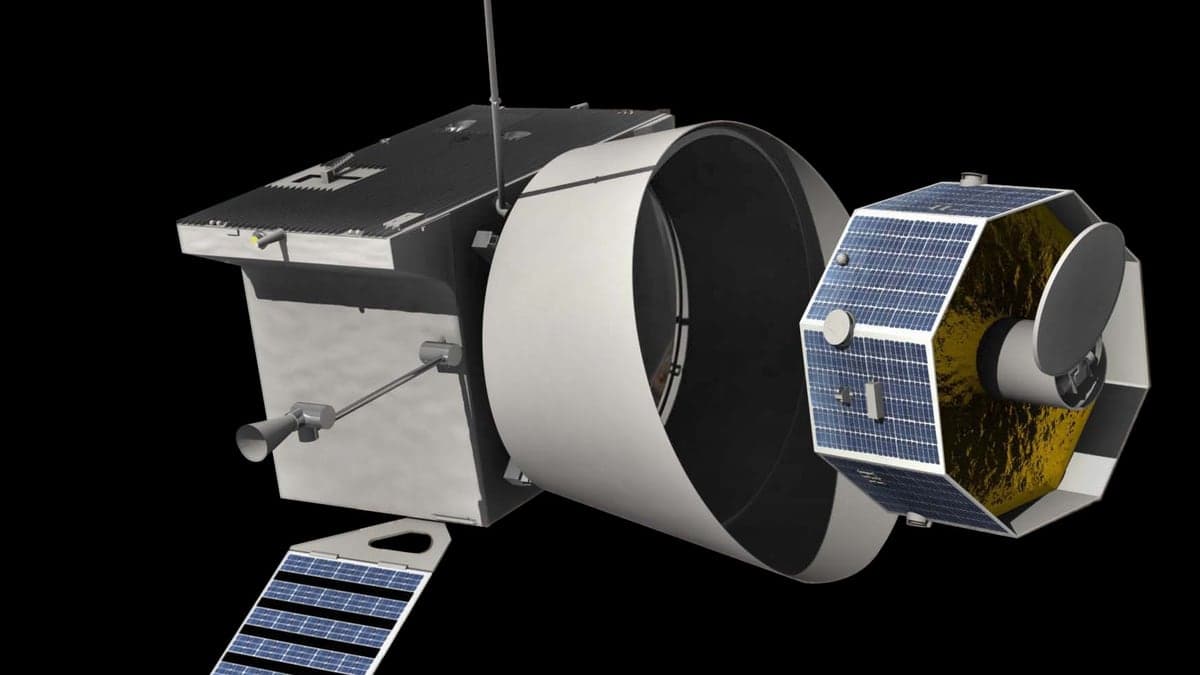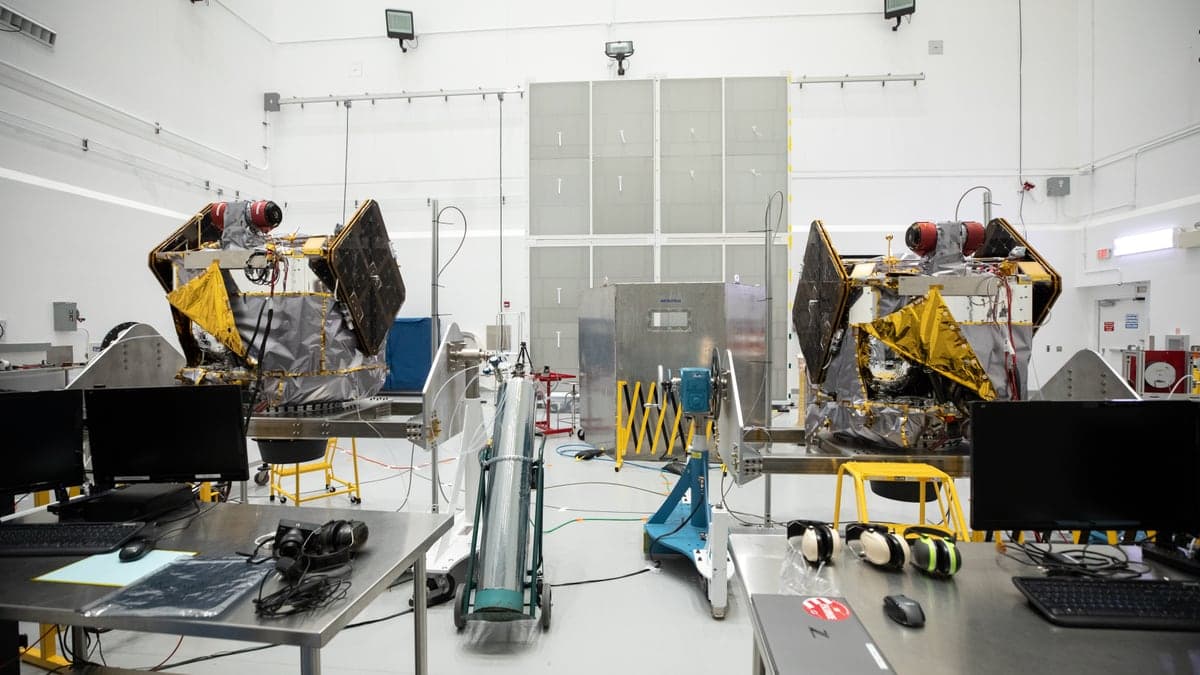
NASA's ESCAPADE Mars mission is finally on its way to the Red Planet. The two identical spacecraft each swung close past Earth on 7 and 9 November 2026 and fired their engines at just the right moment, using the planet's gravity plus their own thrust to break out towards Mars. NASA confirmed that both burns went to plan and the pair are now on a cruise of roughly ten months.
It is a modest mission by budget, but an unusual one by design, and the manoeuvre that just worked could matter well beyond this one flight.
How the ESCAPADE Mars mission took the long way round
Missions to Mars normally launch in a narrow window that opens about every 26 months, when the two planets line up for an efficient transfer. ESCAPADE, short for Escape and Plasma Acceleration and Dynamics Explorers, did not. It launched in November 2025 on Blue Origin's New Glenn rocket, at a time when Earth and Mars were on opposite sides of the Sun.
Instead of heading straight out, the spacecraft were parked in a looping "loiter" orbit around Lagrange point 2, about a million miles from Earth on the side facing away from the Sun. They spent roughly a year there, and the time was not wasted: according to NASA's mission blog, the loop carried them through a distant part of Earth's magnetotail that no spacecraft had directly explored before, yielding bonus science.
Once the planets drifted back into a usable geometry, both spacecraft fell back towards Earth for the slingshot.
The powered flyby, explained
A powered flyby, also called an Oberth manoeuvre, combines two things: the free boost from a planet's gravity and a rocket burn timed for closest approach, where an engine firing delivers the most useful change in orbital energy.
NASA's numbers show how tight the choreography was:
- Spacecraft 1 passed about 1,000 miles above Earth around 5 a.m. EST on 7 November.
- Spacecraft 2 followed around 6 a.m. EST on 9 November at roughly 650 miles altitude.
- Each burn lasted about nine minutes and added more than 1,000 mph, raising speed from roughly 6.3 to 6.7 miles per second.
NASA says this is the first time it has used a powered Earth flyby to send spacecraft to Mars. Asal Naseri, an acting associate flight director in NASA's Heliophysics Division, said the team had "executed this maneuver twice, flawlessly, in just two days."
The real innovation is not the Mars orbit. It is the idea that a small mission no longer has to wait two years for the planets to cooperate.
That is the strategic point. The mission designers at Advanced Space argue the approach lets spacecraft launch almost any time and then use Earth's gravity later, rather than waiting for the next direct window. For cheap, rideshare-style science missions whose launch dates depend on someone else's rocket schedule, that flexibility could be the difference between flying and being shelved. Reusable heavy launchers such as SpaceX's Starship, which caught its upper stage from orbit for the first time this week, are likely to make such opportunistic launches more common.
What ESCAPADE will study at Mars
ESCAPADE is led by the University of California, Berkeley's Space Sciences Laboratory, with Rocket Lab, NASA Goddard, Embry-Riddle Aeronautical University, Advanced Space and Blue Origin among the partners. It is funded through NASA's SIMPLEx programme for small planetary missions.
Its science target is the solar wind, the stream of charged particles that leaves the Sun at around a million miles per hour. Mars lost its global magnetic field long ago, so the solar wind interacts directly with its upper atmosphere and gradually strips it away. Understanding that process helps explain how Mars turned from a wetter world into the cold desert it is today.
The two spacecraft will tackle it in two phases:
- Formation flying. After arrival, the pair will follow each other along the same orbit, sampling the same regions moments apart.
- Split orbits. About six months later, one moves farther out to watch the incoming solar wind while the other stays close to measure how Mars responds in real time.
That makes ESCAPADE the first mission to make coordinated, simultaneous measurements of the Martian environment from two places at once. Principal investigator Rob Lillis calls it "the first science mission to choreograph two orbiters around Mars." NASA also says the results could help plan for future human exploration, since space weather is a radiation and communications risk for crews and equipment.
What comes next
The next milestones are trajectory correction burns during cruise, then Mars orbit insertion on 7 and 9 September 2027, with each spacecraft firing for about 11 minutes. NASA expects several months of manoeuvring before full science operations begin in June 2028.
ESCAPADE sits alongside a busy month for deep space: Voyager 1 is about to become the first spacecraft a full light-day from Earth. For readers following the other big science-and-infrastructure stories of the year, our explainers on AI's growing power problem and the race to post-quantum cryptography cover the energy and security side of the same technology wave.